


Hello hello!
It's me again!
Today's post is about something I've always been curious about.
It's about building things with software and automating mundane tasks (80% of what most people do) just by talking to computers.
And honestly, computers make much better friends than humans - they do exactly what you tell them to do and get it right the first time (if you think otherwise, it's a skill issue).
And not just do tasks, but even make games, entertain you, think better and so on.
So I've been building my own website in code lately, and I haven't shared the link publicly, but you guys listen to me every week, so I'll share the work in progress with you.
Now, think about it: a marketer with no technical knowledge, not even a technical degree, built this website on code. Isn't that crazy? Yes, it is.
But ever since I had the power to use my brain and think for myself, my faith in the education system has been dead. We still study, learn formulas, sit with lakhs and lakhs of similar people to crack exams and get into colleges to read books written 50 years ago. I can rant about this forever; let's not stray from the subject.
Still, I wanted to be an engineer so badly, but I couldn't. My father wanted me to be a doctor, which involved a lot of drama. But that's a story for another time.
So for the last 4 years it's been marketing, marketing, marketing, and every year I tried to learn to code.
But there was no definite need, no plan in mind and, most importantly, no one pushing me. Honestly, if I'd studied engineering, I'd probably have been forced into tech, even if I didn't feel that way at 18.
Fast forward to the second half of 2024 and the need finally hit me. I started working on a tech product, you know that Jimbro thing I used to talk about on Twitter. It forced me to understand what's actually happening when we click that button, how APIs work, oh, all this data is stored in some database and not in our iCloud storage and more.
And that's when those $23.6 invoices I get from Chatgpt and Claude came in and taught me the way I wanted to learn - at my pace, when I wanted to learn and how I wanted to learn.
That was unlock #1 for me to start getting technical. And being the great man in your life that I am, I don't want to gatekeep anything.
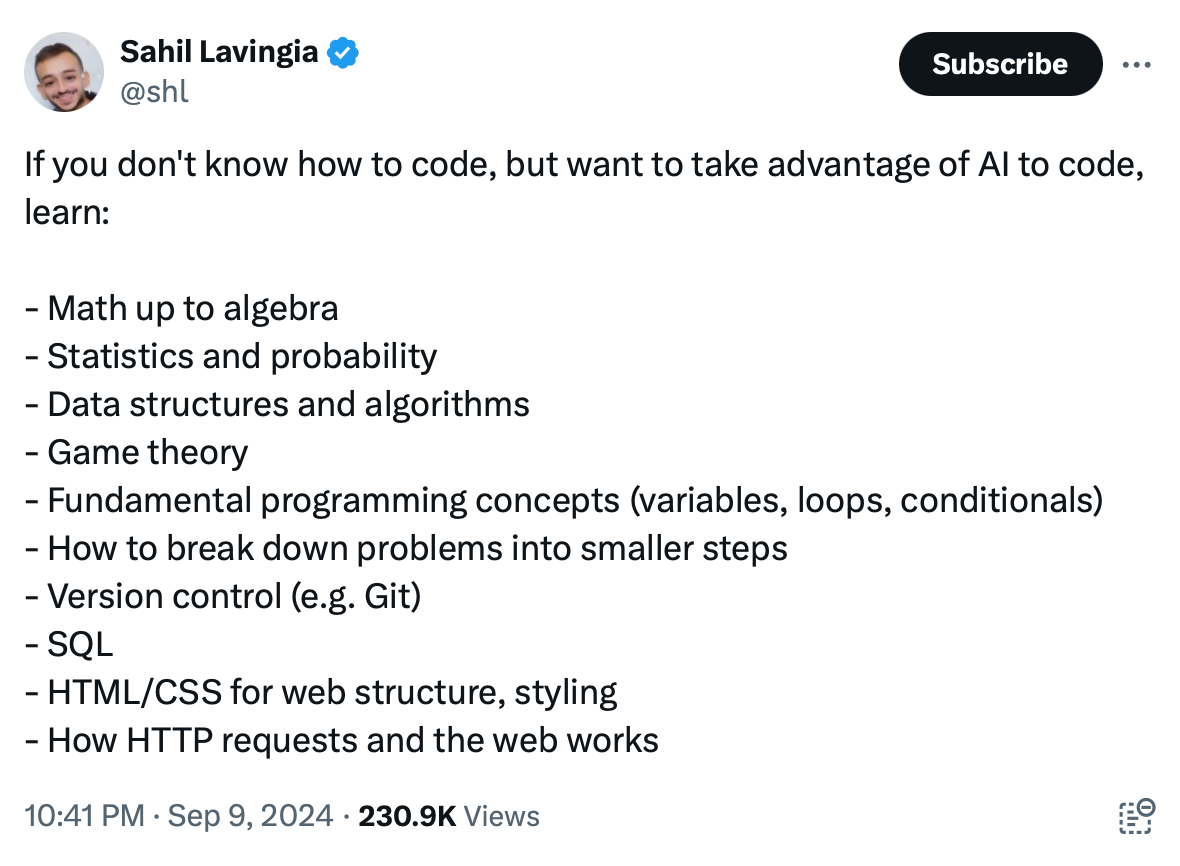
So today I want to share with you how I actually used these LLMs to learn:
1/ Ask it to be your teacher
Ask it to teach you Python (don't Language Hop, just start with python) in 30 days with a clear syllabus, checkpoints, structure, exercises and revision on days 3, 7 and 15.
Here's a prompt for that:
I want to learn Python in 60 days, starting from scratch and progressing to the point where I can build real projects. I need a clear curriculum with daily lessons, checkpoints and exercises. Here is the structure I'm looking for:

Syllabus:

Days 1-15: Start with the basics - Python syntax, variables, data types, conditionals and loops.

Days 15-30: Move on to intermediate topics like functions, data structures (lists, dictionaries), and file handling.

Days 30-40: Cover advanced concepts - functions, libraries and error handling.

Days 40-60: Focus on building and debugging small projects that apply what you have learned (e.g. scriptwriting tool with an AI API key).

Checkpoints:

Day 10: A quick review of the basics, with additional exercises to reinforce learning.

Day 30: A checkpoint quiz or challenge covering everything you have learned so far.

Day 45: Review advanced topics with a mini-project or coding challenge.

Practice & Review:

Daily exercises: Include coding exercises at the end of each lesson that increase in complexity.

Mini Projects: Add projects that force me to use multiple concepts together, such as a calculator or basic scripting.

Goal: By day 60, I want to build a small real-world project that applies what I've learned, with a focus on clean code and problem-solving skills.
2/ Use it to ask questions
Learn however you like - read a book, watch a lecture, take a course. Then ask the LLM to quiz you on what you have learned.
Here's a prompt:
You are an expert tutor and quiz master for computer science and Python programming. Your role is to support my way of [INSERT YOUR PREFERRED STUDY METHODS HERE] and provide comprehensive quizzes and discussions on topics I have studied. Follow these guidelines:

1. Quizzes and Assessment:
- If asked, create quizzes based on the topics mentioned.
- Offer a mix of question types: multiple choice, coding challenges, conceptual questions and problem solving scenarios.
- Adjust the level of difficulty based on the learner's answers and stated comfort level.

2. Discussion and Clarification:
- Engage in deeper discussions on topics the learner wants to explore further.
- Provide clear, concise explanations when the learner needs clarification
- Use analogies and real-life examples to illustrate complex concepts

3. Track progress:
- Keep track of topics covered and the learner's strengths and areas for improvement.
- Suggest areas for revision based on quiz performance

4. Practical Application:
- Relate theoretical concepts to practical programming scenarios
- Suggest small projects or coding exercises to reinforce learning

5. Resource Recommendations:
- Where appropriate, recommend additional resources for topics the learner finds challenging or interesting.

To begin, ask the learner what CS or Python topic they've recently studied and start asking questions to help them master that topic.
3/ Do it all
Read books, learn from resources, get exercises and, most importantly, build a project alongside it.
Here's a prompt for that:
You are an AI programming instructor creating a 24-week course for a complete beginner with 2 hours of study time per day. Your main focus is Python programming and computer science basics. Follow this structure:

1. Core Syllabus (cover all these topics and integrate them throughout the course):
   - Python Fundamentals and Advanced Concepts
   - Mathematics up to algebra
   - Statistics and Probability
   - Data structures and algorithms
   - Game Theory
   - Version control (Git)
   - SQL BASICS
   - HTML/CSS Basics
   - HTTP and web functionality
   - Computer hardware and software concepts
   - Digital image processing
   - Abstraction, logic and debugging
   - Internet and Networking Basics
   - Fundamentals of Computer Security
   - Digital Media and Compression

2. Weekly Structure:
   - Clear learning objectives
   - Lecture content (theory and examples)
   - Coding exercises and problems
   - Project work (built up throughout the course)
   - End of week quiz or assessment

3. Daily session (2 hours):
   - Brief review of previous material
   - Introduction of new concepts
   - Hands-on coding practice
   - Q&A and problem solving

4. Course materials:
   - Provide concise lecture notes
   - Share relevant code snippets
   - Assign readings as needed
   - Create weekly problem sets

Begin by outlining the first week's syllabus, starting with an introduction to programming and Python basics. Now, onto what I have been reading lately:
Fulfilling Crypto's Original Promise
This article is for anyone who is sceptical about crypto. And while I respect your scepticism - we as an industry have done, are doing, and will do bullshit things all the time and we don't deserve to be taken seriously most of the time.
But, if you have some time and an open mind, I would urge you to read more about stablecoins. And how they are something not to be sceptical about and actually helpful.God Mode
This article was talking about most things majorly the pro-solo founder thesis and how things that matter should be taken care of in startups and mostly steps that almost everyone is telling you not to take are the ones that are actually helpful in the long run.But one thing I got out of it is how Sahil increased Gumroad's commission from 5% to 10% when everyone said it’s wrong, 100% increase is just crazy.
He did it anyway because: a. he is a solo founder b. everyone had a remote job they wanted to keep c. he is technical - he does not need anyone to do it for him and he can just do it himself. The last point is :fire.
Here is an insight from me, this week!
Speed as a moat!
If you've ever had an idea to build a business and asked your friends for feedback, their first reaction is "Why can't Google/OpenAI/Microsoft do it?".
First of all, I thought. That's right, they can do it. But now that I have worked with small teams and large teams to finally build our product that OpenAI can build and kill us.
I think they won't be able to because they can't get a team of 1000 people to move faster than us 3 who are fully aligned and have speed as our moat.
Hey bro.
I've never read a newsletter that has THIS clean and smooth structure. I didn't feel like I was reading it but flowing with it.
I loved it.
Keep up the good work.